

Does The Difference Really Matter?
Every year, any time a festival is right around the corner, the same argument breaks out in living rooms. If you’re planning to buy fireworks in Uttarakhand, you’ve probably noticed the huge difference between budget and premium options. Someone wants to go all out on the fireworks and only wants what is considered premium. Another is calculating the expenses, trying to figure out what “all out” actually entails. And then, there’s always that one uncle who swears that the cheap ones from local shops are basically the same thing.
He’s not entirely wrong. But he’s not quite right. There is this assumption about almost everything we buy: spend more, get more. When discussing more in detail, the less flattering version is said: budget fireworks are knockoffs of the real thing, same shape, worse everything. Both ideas are worth questioning, and there is no time like the present to decide what to buy.
When comparing budget vs premium fireworks, most buyers in Dehradun are unsure whether spending more actually improves the overall experience.
If you’re specifically looking for affordable options locally, you can explore our detailed guide on budget fireworks available in Uttarakhand before deciding what fits your celebration.
Are premium fireworks worth it?
Premium fireworks are worth it for large gatherings or special occasions because they offer better color clarity, longer duration, and more consistent performance.
The debate around cheap vs premium crackers often comes down to performance, safety, and overall experience.
Myth 1: “Premium Just Means Better,” Right?
This is perhaps the right place to start. It’s an understandable leap that we have all made, because anything “premium” usually does mean better. Whether it be better build, ingredients, or strength, the list goes on. While it is not a wrong assumption to hold on to, in this context, “better” tends to be more specific rather than a vague term associated with premium.
What you get is refinement that most don’t know how to explain. It’s more vivid colours that burn through the night and your memories. This is all due to higher-grade metal salts, like barium for green and strontium for red, that significantly cost more and behave more predictably at combustion. That beautiful willow burst, fanning out slowly and symmetrically while your jaw hangs in awe, is no accident. It’s a perfectly timed effect that is the result of careful shell construction and well-tested fuse timings.
In the end, you’re also paying for consistency, the price driver beyond chemistry. Manufacturing precision matters; there’s a huge difference in the behavior of a well-balanced shell than in that of one that is slightly off-center. While a fair chunk of what you pay is just packaging and brand reputation, there is also the added benefit of new effects that premium brands spend a lot of money on to develop. Overall, premium fireworks are a more polished experience than their cheaper counterparts.
Premium fireworks in Uttarakhand are commonly chosen for weddings, large gatherings, and festive nights like Diwali.
So, “better” depends on what you’re looking for. Premium makes sense when you want a wow factor at a large gathering. Whereas a few rockets in the backyard with your family make you wonder if premium would be worth it, or perhaps too much for the moment.

Myth 2: Are Budget Fireworks Actually Dangerous?
This question worries people, and it is valid, but it isn’t the whole truth. Large-scale manufacturers, the ones that supply premium brands, have more to lose from a quality control failure. The Petroleum and Explosives Safety Organisation (PESO) governs the firework licensing and certifications that reputable manufacturers at any tier are supposed to follow. But compliance is enforced unevenly, leading to smaller-budget producers cutting corners in ways that aren’t visible until something goes wrong.
The actual safety risk for any fireworks comes down to three things that have nothing to do with their price:
- Where did you buy it
- How old is it
- How it’s been stored
Regardless of what they cost, any fireworks that have been sitting in a damp godown for two monsoons are a problem. Any reputable local retailer who stores stock properly and sells it quickly, instead of letting it sit on the shelf for months, is selling you something safer than a premium product that has been mishandled.
In cities like Dehradun, Haridwar, and Rishikesh, storage conditions during the monsoon season can significantly affect firework quality.
Trusted retailers like Arora Fireworks follow proper storage practices and comply with PESO guidelines to ensure safer products.
It usually isn’t easy to tell from the box how old it is. The safest moves are to buy from established sellers, check for visible licensing marks, avoid anything that seems waterlogged or roughed up, and steer clear of roadside setups that appear with no fixed addresses.
Myth 3: You Get What You Pay For
Although this statement feels true, there are quite a lot of cases where this isn’t always true. Everyone has at least one crazy firework story, whether it’s when their premium multi-shot barrage fizzled out on shot three or perhaps when a budget assortment box produced a movie-worthy red-and-gold burst of color. What you spend is not a guarantee but merely a possibility of what is to come.
When you choose premium brands, you simply choose what has a higher probability of working right. They have a lower failure rate, often performing as they are intended, but fireworks are still a little unpredictable. The open air, humidity, wind, and fuse timing can affect the combustion, so even the best ones can occasionally surprise you.
Budget fireworks have a reputation for being unpredictable, with more misses in their reputation. But there are also those occasional surprise wins. So, if you want to make the evening a little bit more exciting, perhaps you could invest in some budget fireworks to stir up some trouble.
Budget vs Premium Fireworks: What Will You Actually Notice?
Now that the myths are out of the way, let’s move on to what one would actually see and hear. This is where the real differences emerge between budget vs premium fireworks.
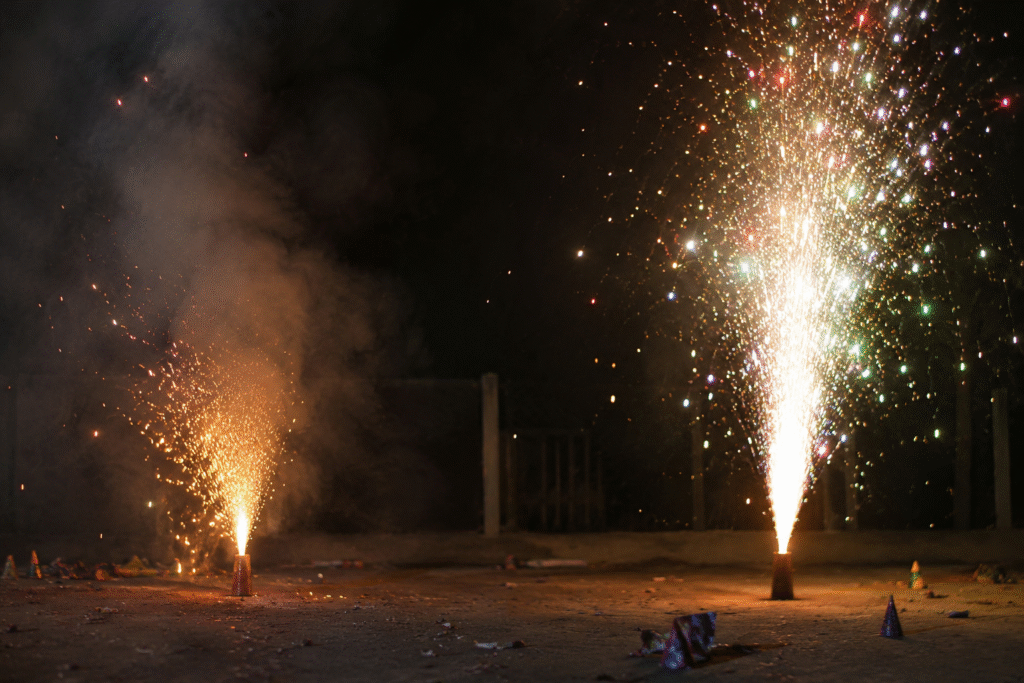
Colour, the most noticeable one out there. Premium brands provide deeply saturated hues that paint the sky with the various lights of electric blue or clean white. Meanwhile, budget options drift toward the reds and yellows because they are cheaper to produce. However, they tend to look a little washed out in mass-produced, large mixed boxes where the exact color mix isn’t tightly controlled from piece to piece.
Effect variety, on the other hand, is where budget fireworks seem to have closed the gap in recent years. Various crackle and strobe effects that seemed exclusive to premium-produced shells are now showing up in mid-range and lower-budget packets. Although the execution isn’t always clean or consistent, the effects themselves are available for a budget.
Unfortunately, the gap between premium and budget is noticeable when talking in terms of duration. On a budget, you get fast and loud-burning fireworks while premium ones take their time. Premium holds longer and fades gracefully. The “hang time” in the sky is satisfying and hard for a cheaper build to replicate.
And finally, at the end, sound matters more than people think. The deep, chest-resonating boom that you always expect comes down to the shell size and propellant quality, which budget fireworks more often than not tend to lack. Instead, they have a sharper, higher crackle that is a different experience altogether.
| Feature | Budget Fireworks | Premium Fireworks |
|---|---|---|
| Price | Low | High |
| Color Quality | Basic | Vibrant & rich |
| Duration | Short | Longer-lasting |
| Reliability | Inconsistent | More consistent |
| Best For | Casual use | Events & finales |
But What Should You Actually Spend?
In the discussion of budget vs premium fireworks, pricing plays a major role in determining what works best for different types of celebrations.
For a considerably small gathering, perhaps within 15 people, a budget of ₹1500 – ₹2500 should be workable. A mixed assortment box from a mid-tier budget brand is affordable within this range. Stretching it to ₹2500, a couple of aerial shots can also be added that would provide a memorable end to the evening.
For a larger celebration where there are easily more than 40 people, the math changes. A meaningful premium selection costs somewhere between ₹6000 and ₹8000. It consists of enough visual variety to make it feel like a complete show. Most people end up mixing tiers anyway, which is a smart decision. The big finale shots can be taken up by the premium fireworks, while the earlier part of the evening is filled with reliable fountains and sparklers on a budget. You get the spectacle where it counts. In Dehradun, most families prefer a mix of budget and premium fireworks during Diwali and wedding celebrations.
How much should you spend on fireworks?
For small family celebrations, ₹1500–₹2500 is usually enough. For larger events or weddings, ₹6000–₹8000 provides a more complete and visually impressive experience.
Then There’s The Pollution Question
If you live in a city like Delhi, Lahore, or Dhaka, where the air quality is pretty bad, then you should know that both budget and premium fireworks pollute. It is simply a firework problem.
There is a difference in the degree of their pollution. Premium manufacturers are investing in low-smoke formulations, with Indian brands producing “green crackers.” The Council of Scientific and Industrial Research (CSIR) certifies them, claiming to reduce emissions by 30%. The mid-to-premium range of fireworks usually consists of this formulation.
Budget fireworks, especially the unbranded ones, tend to stick to the older formulation that releases more particulate matter per burst. This is because the formulation itself costs money. One can wonder how the difference in one rocket can be measured. But when bursting them for a whole evening, it adds up. Similarly, every household in the city would also be doing the same thing. The cumulative effect on city air quality is quite significant.
The best option would be to stick to buying PESO-certified green crackers and keep it shorter but better. This makes the experience less damaging to the environment.
Conclusion
So, should you go budget or premium?
Invest in budget fireworks when it’s just close family, or you’re buying for kids who are more interested in sparklers, or you’re trying to fill up a lengthy evening. Save the premium shells for the finale. Go premium when the occasion matters. Buy it when you know people are going to be watching, and you want a memorable and reliable visual. In the end, choosing between budget vs premium fireworks depends on your event size, expectations, and budget.
Ask yourself three things:
- How many people are watching?
- What is your centrepiece moment?
- Are you choosing a long evening or a short show?
Answer those questions, and your budget almost decides itself, helping you also make sense of what fireworks you should pick out.
Visit Arora Fireworks in Dehradun to explore certified, well-stored budget and premium fireworks and choose the right combination for your celebration.
Frequently Asked Questions
Q: Is mixing budget and premium fireworks a good idea?
Yes, it’s what most experienced buyers do. The evening becomes magical when you know which tier to use where. You get the spectacle you want, where it counts, and you don’t need to spend a lot on premium for the entire evening.
Q: Where would be the best place to buy fireworks, and how do I find a legitimate brand?
Look for established retailers who have a fixed address. Make sure they have a consistent seasonal presence. This ensures that their stock is stored properly. When you’re buying the fireworks, look for the PESO license number on the packaging, as reputable manufacturers are required to display this.
Q: Are green crackers actually better for the environment?
They are better than conventional ones, but they aren’t a clean alternative. Green crackers use a reformulated compound that reduces particulate emissions by nearly 30% compared to standard crackers. “Green” does not mean zero emissions in this case. There is still combustion and smoke contributing to the overall load of the night. But it does mean a meaningful reduction on a larger scale. They’re a responsible choice.


 By
By