

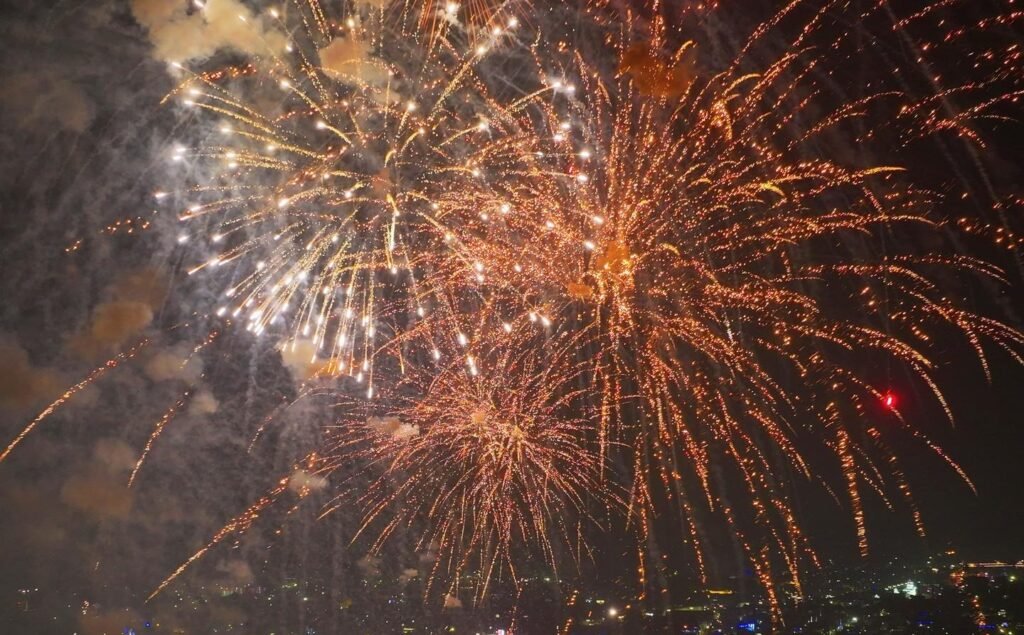
Designing an aerial fireworks display that actually works one that holds an audience’s attention from start to finish requires more than picking whatever looks good in a catalogue. Every aerial fireworks type behaves differently in the air: it travels to a different height, burns for a different duration, and creates a different sensory impression. Rockets punch upward. Cakes command the middle sky with rhythm and scale. Fountains hold the ground with sustained, crackling intensity. Know which does what, and you can sequence a show that builds from quiet wonder to a memorable climax. This guide breaks down all three mechanics, visual impact, safety rules, and the right event for each.

There is a time and place for all of these aerial fireworks within a show. Selecting the proper fireworks display is contingent upon the area you have to work with, how much money you have, and the “mood” that needs to be created. Whether you are planning wedding & anniversary fireworks or a large-scale public event, this guide provides a deep dive into each of the three fireworks, including their mechanical properties and safety concerns.
Sky Rockets: The High Flying Fireworks
The rocket is the most recognisable of all aerial fireworks, a self-propelled shell that punches skyward in a streak of light before exploding into a symmetrical burst high above the crowd. For events where visibility across a wide area matters, think open fields, rooftops, or beachfronts, nothing else competes.
How Rockets work
A rocket consists of a motor, a main fuse, a wooden stabiliser stick, and a payload shell at the top. When the fuse is lit, combustion gases generated by the propellant push the rocket upward at speed. The stabiliser tail keeps the trajectory straight. Once at peak altitude typically between 30 and 60 metres a time-delay fuse ignites the burst charge inside the shell, dispersing the colour-producing stars outward in symmetrical patterns. Encyclopædia Britannica’s entry on fireworks describes how the rocket’s case is engineered to produce maximum combustion thrust in its earliest stage, optimising both height and stability before the burst.
Visual Experiences
The ascent: A distinctive whoosh or screeching sound builds as the rocket climbs — that audio is half the experience.
The break: Rockets usually burst into very symmetrical shapes; the altitude gives a feeling of grandeur.
The variety: All types of breaks are possible willows, peonies, and salutes.
Best used for
Rockets are the punctuation of any pyrotechnic display deployed at key moments to draw the eye upward and signal a transition. They are ideal for large-scale wedding and anniversary displays, entertainment and celebrity events, and open-venue sporting occasions where visibility above tree lines and rooftops is essential. Their limitation is space: rockets require clear vertical and fallout zones, making them unsuitable for confined or urban settings.
Fireworks Cakes
If rockets are soloists, cakes are the full orchestra. Officially classified as multiple-tube devices, firework cakes deliver 20 to 500 sequential aerial shots from a single ignition point, no reloading, no multiple fuses, no gaps in the performance.
How They Operate
A cake consists of a block of cardboard cylinders anywhere from 9 to 500 individual tubes each loaded with an aerial shell and all connected through an internal zigzag fuse. Light one end, and the device fires automatically in sequence, volley by volley, for 30 to 90 seconds. The block shape, often square or hexagonal, gives the product its name. Most contemporary cakes fan their tubes outward at angles so the simultaneous shots form a wide, layered wall of color across the sky rather than a single narrow column. They are a staple choice for corporate event pyrotechnic shows and theme-based cultural celebrations where sustained visual impact is brief.
The visual display
Timing and rhythm: Some cakes build slowly to a frenzied finish; others shoot volleys of five to ten breaks at once.
Varied effects: A single cake can deliver “crackling dragon eggs,” “silver fish,” and “multicolor dahlias” all in one fuse. Far more variety than a comparable number of single rockets.
Angled launches: Fanned-tube cakes spread shots across 60–180 degrees, creating a panoramic wall of aerial color rather than a vertical shaft.
Best used for
Cakes form the structural backbone of any professional pyrotechnic display, providing the sustained duration that holds audience attention between accent moments. They work brilliantly for theme parties and cultural shows, and large public gatherings where rhythm, scale, and continuity are the priority. Because the entire sequence fires automatically, cakes also dramatically reduce the operational complexity of running a solo show.
Fountains: Ground-level pyrotechnic spectacle
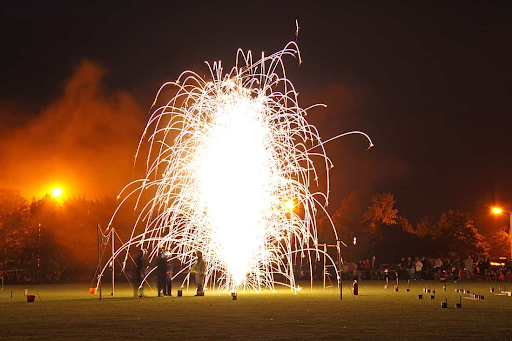
Aerial fireworks do not always have to involve the sky. Fountains often called ground fireworks or gerbs stay earthbound but produce dramatic, volcano-like columns of sparks and colored light that can be more intense at close range than almost any airborne effect.
How do fountains work?
A fountain is a cardboard or pressed-paper cone or cylinder containing a pyrotechnic mixture. Unlike rockets or cakes, it has no lift charge: combustion takes place inside the casing and forces sparks and burning particles upward and outward through a nozzle. This gives fountains their characteristic broad, spreading plume rather than a sharp aerial burst. Their contained burn makes them an excellent opening act for any motion-lighting or SFX-integrated show, building atmosphere before the high-altitude elements begin.
The sensory experience
Intense up close: Proximity turns a fountain into a full sensory experience; the crackle, heat, and light are genuinely felt by nearby audiences in a way aerial shells are not.
Duration: Large conical fountains can burn for up to three minutes longer than any rocket or cake making them ideal for sustained atmospheric effects during ceremony moments.
Layered effects: Premium fountains shift colors mid-burn, from deep amber through titanium silver, and may add intermittent whistles or crackles for textural variety.
Best used for
Fountains are the safest choice for venues with overhead obstructions, power lines, tree canopy, marquee frames where launching any aerial fireworks shell would be hazardous. They suit residential garden events, indoor-adjacent celebrations, and any setting where children or elderly guests are present and loud aerial bursts would be unwelcome. They also serve as effective aisle-lining or stage-framing elements for weddings and ceremonies.
Comparative Breakdown: Which One Should You Choose?
| Feature | Rockets | Cakes | Fountains |
| Altitude | Very High (100ft – 200ft+) | Medium to High | Ground Level (0 – 15ft) |
| Effort | High (Load each one) | Low (Light one fuse) | Low (Light one fuse) |
| Duration | Short (One burst) | Long (30 – 90 seconds) | Longest (1 – 3 minutes) |
| Noise Level | Loud Bang | Repeated Bangs | Hissing & Crackling |
| Safety Zone | Large (Clearance above) | Large (Clearance above) | Small to Medium |
| Best event type | Open-air, large crowds | Any professional show | Confined or family events |
| Visual Impact | High altitude, bold burst | Sustained,rhythmic fill | Intense,close-range plume |
The Chemistry behind Colors
Every color in any aerial fireworks display whether produced by a rocket, a cake, or a fountain is the result of metal salts burned at precise temperatures. Encyclopædia Britannica’s fireworks reference explains that for colored effects, a metal salt that determines the hue is combined with potassium chlorate or perchlorate, which controls the combustion temperature.
As EarthSky’s guide to fireworks colors details, each metal salt emits light at a specific wavelength when heated:
- Red: Strontium Salts (Strontium Carbonate)
- Orange: Calcium Salts (Calcium Chloride)
- Yellow: Sodium Salts (Sodium Nitrate)
- Green: Barium Salts (Barium Chloride)
- Blue: Copper Salts (Copper Chloride) — one of the hardest colors to produce, making it a hallmark of a good firework.
The physical form of the pyrotechnic composition differs across the three types. Rockets use dense, compressed stars designed to survive rapid acceleration. Cake stars are typically larger to produce the wide “dahlia” burst effect. Fountains use fine-grained mixtures rather than discrete stars, producing a smoother, sustained flame plume. The Chemical Safety Facts overview of pyrotechnics history traces these formulation differences back to 19th-century Italian innovations that introduced metal salts to what had previously been monochrome explosive displays.
The National Inventors Hall of Fame explains that silver and white effects come from combining titanium, zirconium, and magnesium. For a further breakdown, Science Friday’s fireworks color resource traces how the Italian discovery of metal-salt coloring in the 1830s transformed pyrotechnics from simple noise-making into the color-saturated spectacle we know today.
Safety and Planning: The Golden Rules
Physics and fire behave the same way regardless of which aerial fireworks type you are using. Every professional pyrotechnic team follows the same core protocols and so should any buyer handling consumer-grade products.
The Surface Factor
Rockets require a stable launching tube secured to a fixed base. Never press a rocket stick directly into soil if it tilts, it becomes a horizontal projectile aimed at ground level.
Cakes must sit on a flat, hard surface. Surround the base with bricks or sandbags to prevent the device from rocking under the recoil of repeated shots.
Fountains must be placed on a perfectly level surface to prevent the plume from tilting toward spectators. Even a slight incline can redirect burning particles toward guests.
Dud Firework Rule
If your firework doesn’t go off, never approach it immediately. Wait at least twenty minutes, then douse it in water. “Hang-fire”, a slow-burning fuse that ignites unexpectedly is a real danger. The National Inventors Hall of Fame explains the mineral science behind fireworks and why dud handling matters.
Know the Audience and Neighbors
Rockets and cakes project sound and fallout across significant distances. Check local regulations before any display, and ensure that your designated fallout zone does not extend over neighboring property, vehicles, or gathered crowds. For events involving children, elderly guests, or noise-sensitive animals, prioritise fountains or low-noise cake variants.
How to build the ideal aerial fireworks display
The most memorable shows combine all three types in a deliberate sequence. Here is a proven three-act structure that professional pyrotechnicians use to build and release audience tension effectively:
- Act one — opening (fountains): Begin with a row of quality conical fountains to pull attention and build anticipation. The sustained crackle and rising plume create an atmosphere without overwhelming guests.
- Act two — body (cakes): Introduce 20-shot cakes and gradually work up to 100-shot and 500 g cakes. This is the structural heart of the display — sustained, rhythmic, and visually rich. Layer different effect types to keep the sky varied.
- Act three — accent and finale (rockets): Weave single rockets between cake volleys to add vertical punctuation. For the finale, fire multiple cakes simultaneously while launching several rockets the combination of sustained fill and high-altitude burst creates the crescendo effect audiences remember.
Why Choose Arora Fireworks?
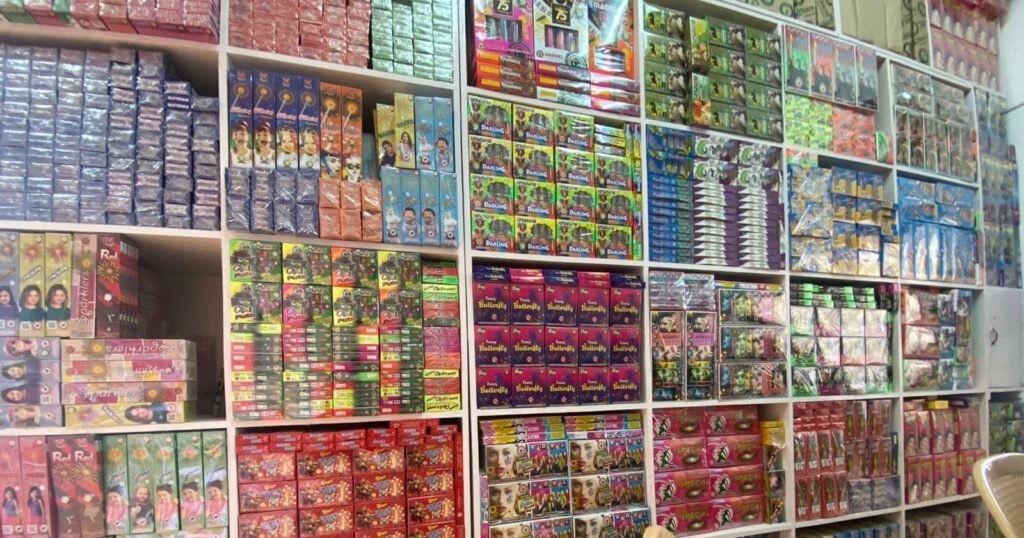
At Arora Fireworks, we work with event planners, retailers, and direct buyers across every scale of celebration. Whether you need a curated selection of consumer-grade aerial fireworks or a fully managed professional show, we supply the right mix of rockets, cakes, and fountains for your venue, crowd, and budget all compliant, all quality-checked. Contact our team to discuss your event requirements, or learn more about how we work with buyers and event teams across India.
Conclusion
Rockets, cakes, and fountains each bring something distinct to an aerial fireworks display and none of the three is dispensable. Rockets provide height and grandeur. Cakes deliver sustained visual impact and rhythm. Fountains build atmosphere at ground level and widen the range of events where pyrotechnic effects are safely possible.
Choosing the right combination depends on your venue’s dimensions, your audience’s profile, and the emotional arc you want the show to follow. If you would rather leave the planning to professionals, reach out to Arora Fireworks we will handle everything from product selection to on-site execution.
Frequently Asked Questions
1.Which aerial firework type is best for beginners?
Fountains and small cakes are the best starting point. Both ignite from a single point, stay at ground level or low altitude, and require minimal setup. Rockets demand more precise launch preparation and significantly larger safety zones.
2. Can you use rockets in a backyard?
Only if you have a genuinely large, open space with no overhead obstructions, clear fallout zones in all directions, and compliance with local regulations. For most residential gardens, cakes or fountains are the safer and more practical choice.
3. How long do firework cakes last?
Cakes typically burn for 30 to 90 seconds, depending on the shot count and the internal fuse timing. A 20-shot cake burns faster than a 200-shot cake even if both appear similar in size, because the shell calibre and timing differ.
4. What makes aerial fireworks produce different colors?
Color comes from metal salts burned at specific temperatures. Strontium produces red, barium produces green, copper produces blue, and sodium produces yellow. Blue is the hardest color to achieve because copper compounds destabilise at high combustion temperatures.
5. What should you do if a pyrotechnic device fails to ignite?
Walk away immediately. Wait a minimum of 20 minutes before approaching, then soak the device thoroughly in water before handling it. Never attempting to relight a device that has already been ignited by a hang-fire is a documented and serious hazard.
 By
By