

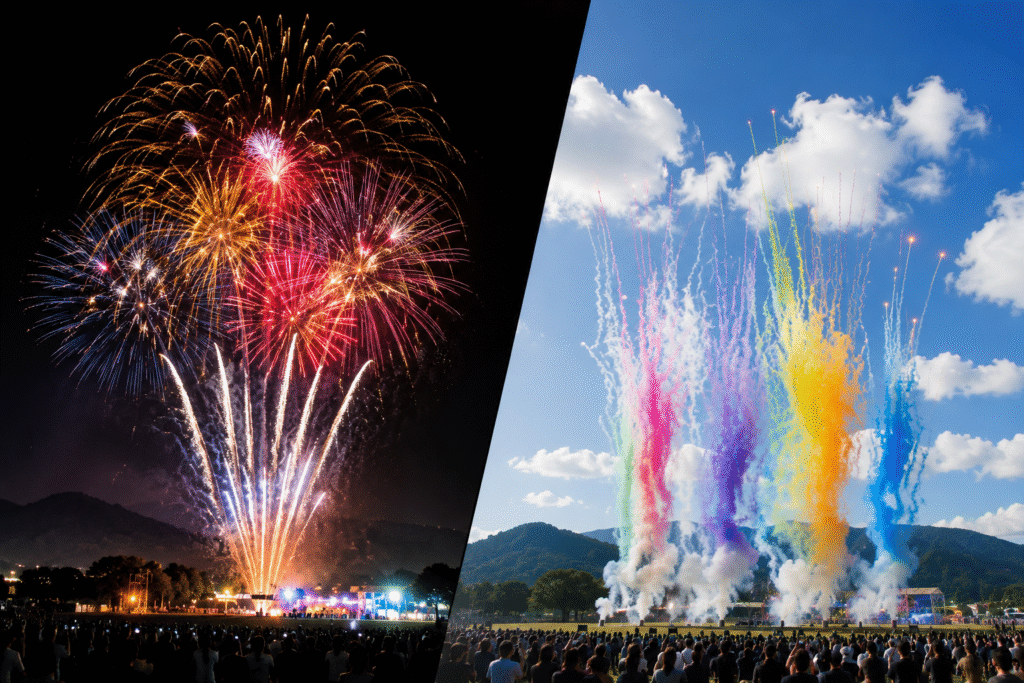
For decades, fireworks were strictly a nighttime experience, with darkness acting as the perfect canvas for their brilliance. Today, that rule no longer holds. From corporate launches and music festivals to sporting events and afternoon weddings, both daytime fireworks and night fireworks are used to create impact.
Whether it’s a wedding celebration with night fireworks or a corporate event using daytime fireworks, the type of display you choose directly shapes how your audience experiences the moment.
But here’s the challenge: traditional nighttime fireworks don’t work under a bright sky. Instead of vibrant visuals, they fade into faint flashes followed by dull smoke.
Daytime fireworks and night fireworks are fundamentally different. Night displays rely on light and contrast, while daytime effects depend on color, sound, and structure. Choosing the wrong type can weaken the entire event experience.
This difference exists because of how light behaves. In daylight, intense ambient brightness makes it difficult for light-based effects to stand out. At night, near-zero ambient light allows even subtle effects to shine vividly.
As a result, manufacturers design completely different compositions for each setting, making it essential to match your fireworks with the timing of your event.
Choosing the right daytime fireworks or night fireworks isn’t optional anymore, it defines the success of your event, and with Arora Fireworks, you get displays engineered for the perfect impact at any time of day.
Night Fireworks for Events
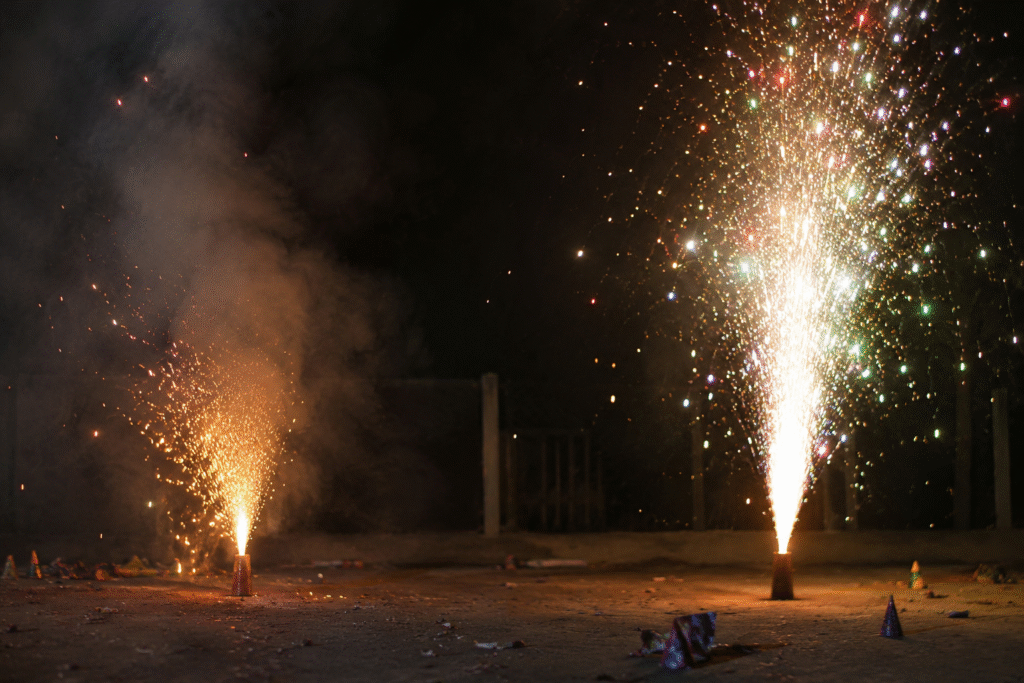
Fireworks are intricately associated with the night. Night displays are the classic, contrasting image that we think of when we hear fireworks.
The reason is simple: the dark, empty sky serves as a perfect backdrop for the vibrant visuals that fireworks create. Nighttime fireworks rely on complete chemical light emission. The firework is a traditional shell with materials compressed into small spheres called stars. The stars contain mixtures of metal salts and oxidizers. When lit, these stars burn at temperatures exceeding 100 degrees Celsius, this causes the metal electrons to return to lower energy states, releasing photons as they do so.
Since the night sky is dark and non-reflective, the human eye can easily identify and enjoy the burning points of light. This even allows long-duration patterns like willows and brocades, phenomena where the viewer can track tiny flakes of gold or silver charcoal as they drift to the ground, to occur. These classic night fireworks remain the top choice for weddings, galas, and milestone celebrations.
Daytime Events
The situation obviously changes when we consider the day.
Trying to create a source of light that outshines the sun requires an impractical and hazardous amount of energy. Because of this, most daytime fireworks abandon light emission entirely and pivot to color. Instead of burning metals like nighttime crackers, daytime shells use highly stable organic dyes blended with combustion agents such as potassium chlorate and lactose. Pyrotechnic compositions and color production explain how these reactions generate colored smoke. When a daytime cracker is set off, it doesn’t create a flash of light; the heat vaporizes the organic dye, and the expanding gas forces it out into an aerosol cloud.
Instead of emitting light, daytime fireworks effectively block and reflect the existing sunlight. Since we are also most likely looking at these fireworks against a blue or white backdrop, manufacturers use saturated, high-contrast pigments like yellow, magenta, violet or orange to stand out against the surrounding sky. This is what makes daytime fireworks ideal for high-energy, brand-forward events.
When to use Daytime vs Night Fireworks
Since the mechanics of daytime and nighttime fireworks are so fundamentally different, the use cases for both also naturally differ.
Daytime crackers are suited for high-energy environments where you need to capture a crowd’s attention. For example, during a football match, firing a rapid sequence of fireworks allows you to paint the sky with a team’s colors, igniting team spirit within the crowd. Another instance for daytime firecrackers is a midday festival where fireworks can be synchronized with the audio and beat drops.
On the other hand, Nighttime fireworks are built for emotional, immersive moments. Corporate Galas or Wedding receptions are events where nighttime fireworks would thrive. Choosing the right fireworks for events, from sports event fireworks to wedding fireworks, ensures maximum crowd impact.
Atmospheric logistics
The differences between nighttime and daytime fireworks aren’t purely cosmetic. The way these two types of crackers interact with the atmosphere requires entirely different logistical planning. Planning outdoor event fireworks around these atmospheric factors is key to a flawless show.
During the day, solar radiation constantly heats the Earth’s surface. This creates thermal updrafts, which are columns of warm, rising air. When you use daytime fireworks, these convective currents will pull colored smoke upwards and outward much faster than it would move at night. If the afternoon is windy, the smoke will dissipate within moments, completely ruining the visuals.
Conversely, on a calm, hot afternoon, the thermals can lift a dense cloud of pink or blue smoke straight into local flight paths. If your venue is within a few kilometres of an airport, a prolonged daytime show can pose visibility hazards, as a lingering dye cloud can reduce visibility.
At night, the challenge flips. As the ground cools after sunset, it creates a temperature inversion, a layer of warm air sitting directly above a layer of cool air. When you use a nighttime firework in this situation, the heavy smoke produced by the black powder rises, hits the inversion layer, and flattens out. Essentially, they get trapped in the site where you are using the fireworks. Within minutes of the first firework being launched, the bright colors of the fireworks will illuminate their own smoke, which is slowly turning into smog.
When using fireworks at night, it is important to look for a steady breeze which helps to clear the smoke after fireworks and additionally, to pace yourself when firing the crackers to allow the smoke to dissipate.
Conclusion
To have a successful event, it is important to adapt to your environment rather than resist it. Nighttime fireworks are perfect for deep, emotional events where visual immersion is key. Daytime fireworks are great to boost the energy within a crowd and build people’s enthusiasm.
By matching your firework to the event and the event to the environment you want to create, you can ensure that the mood and atmosphere within the event is perfect. Even after deciding on a nighttime or daytime event, it is imperative to consider the wind on the day of the event to ensure maximum output from your fireworks. These fireworks safety guidelines and the list of authorized fireworks approved by PESO help event planners choose compliant, safe, and high-quality fireworks for any event.
For professionally designed daytime fireworks and night fireworks that deliver maximum impact with safety and compliance, trust Arora Fireworks to execute your event flawlessly.
Frequently Asked Questions
How does the humidity affect daytime and nighttime crackers?
High humidity is good for nighttime fireworks since water vapor in the air helps refract and amplify the illumination they produce, which appears yellow. For daytime fireworks, high humidity is a nightmare. The moisture binds to the dye- which makes the smoke heavy and sluggish. This means that the dyed smoke has a chance to fall towards the audience rather than hang in the air.
Can you create a silent show to avoid noise pollution using either daytime or nighttime fireworks?
A completely silent show is impossible since both daytime and nighttime fireworks use black powder to launch the shell out of the mortar tube. This creates an unavoidable thump sound.
Daytime shows are much easier to scale down in terms of noise. You can run a purely visual daytime show by using low-pressure canisters that emit colour through chemical reactions rather than explosive breaks. Nighttime fireworks almost always require explosions to heat the star, causing the explosion of light. This means that it is impossible to run a silent nighttime show. For noise-sensitive venues, low noise fireworks are the smarter daytime choice.
How do chemical cleanup protocols differ when a daytime show finishes versus a night show?
Nighttime shows leave behind substantial amounts of carbon, unburnt charcoal, and heavy metals, which are largely biostable but require thorough sweeping for cardboard casings. Ultimately, you need to sweep the surrounding areas from where you launched the fireworks.
Daytime shows leave behind synthetic pigments. If these pigments settle on damp areas, cars, or important structures in wet conditions, they can leave stains that are hard to get out. Cleanup for a daytime show frequently involves the immediate pressure washing of ground surfaces. Following proper fireworks smoke cleanup protocols keeps venues safe long after the show ends.
 By
By